




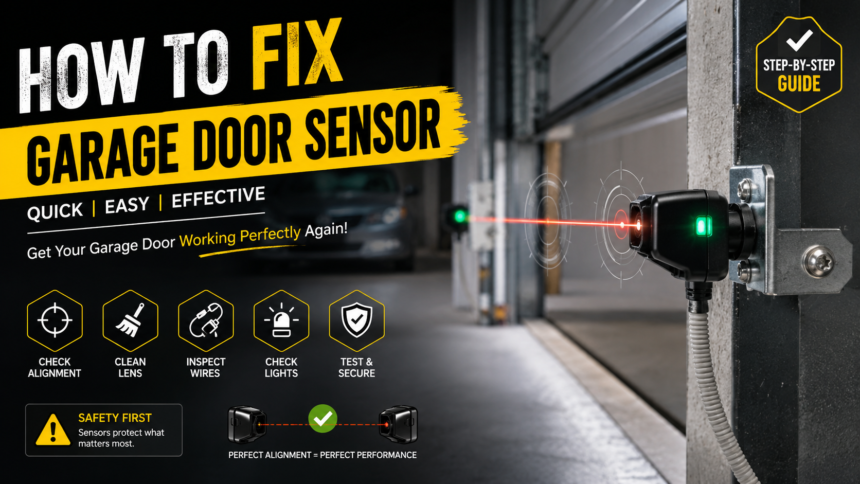
A garage door that refuses to close properly can be frustrating, especially when everything else seems fine. In most cases, the real issue is the sensor system.
- Understanding Garage Door Sensor System in Detail
- Why Garage Door Sensors Fail More Often Than You Think
- Step-by-Step Repair Process (Advanced Method)
- Step 1: Complete Power Shutdown
- Step 2: Observe Sensor Behavior Carefully
- Step 3: Precision Realignment (Most Important Step)
- Step 4: Deep Lens Cleaning
- Step 5: Full Wiring Inspection
- Step 6: Sunlight and Reflection Adjustment
- Step 7: Reboot and Functional Testing
- Deep Dive: Alignment Science Explained Simply
- Wiring Issues: Hidden but Common Problem
- Sensor Replacement: When Repair Is Not Enough
- Common Mistakes People Make During Repair
- Preventive Maintenance Strategy
- Real-World Scenario
- Long-Term Reliability Tips
- Final Thoughts
This guide on how to fix garage door sensor goes deeper than basic fixes. It explains not only what to do, but also why the problem happens and how to prevent it in the future.
As one experienced technician puts it, “Garage door sensors are simple devices, but they react strongly to the smallest disturbance.”
Understanding Garage Door Sensor System in Detail
To properly master how to fix garage door sensor, you must first understand how the system works at a deeper level.
Garage door sensors are usually placed near the bottom of the door tracks on both sides. One sensor sends an infrared beam, and the other receives it.
If the beam is uninterrupted, the door closes normally. If anything breaks the beam, the door automatically stops or reverses.
This system is designed to prevent accidents involving:
- Vehicles
- Children
- Pets
- Objects in the door path
Think of it like a “digital safety line” that the garage door refuses to cross if anything feels unsafe.
When people search how to fix garage door sensor, they usually face one thing: the system is detecting a problem even when nothing is visibly wrong.
Why Garage Door Sensors Fail More Often Than You Think
Before jumping into repairs, it’s important to understand the deeper reasons behind failures. This makes how to fix garage door sensor much easier and more effective.
1. Environmental Impact
Garage sensors are exposed to:
- Dust
- Heat
- Humidity
- Sunlight
Over time, these factors slowly affect performance.
2. Physical Disturbance
Even a slight bump from:
- Bicycles
- Storage boxes
- Cleaning tools
can shift alignment without you noticing.
3. Electrical Instability
Loose wiring or voltage drops can interrupt signal transmission.
4. Aging Components
Like any electronic device, sensors weaken over time and become less reliable.
Understanding these causes is the foundation of how to fix garage door sensor correctly.
Step-by-Step Repair Process (Advanced Method)
Now let’s go deeper into practical repair steps for how to fix garage door sensor.
Step 1: Complete Power Shutdown
Always start by disconnecting the garage door opener from power.
This prevents accidental movement during inspection.
It’s a basic step, but crucial for safety when learning how to fix garage door sensor properly.
Step 2: Observe Sensor Behavior Carefully
Check both sensors closely.
Look for:
- Solid LED light
- Blinking light
- No light at all
Each pattern tells a different story.
A blinking light usually indicates misalignment, while no light often points to wiring or power issues.
Step 3: Precision Realignment (Most Important Step)
Misalignment is the most common issue in how to fix garage door sensor cases.
To realign:
- Loosen mounting brackets slightly
- Adjust sensors until they face each other directly
- Ensure both are at equal height
- Tighten brackets carefully
Even a 2–3 mm shift can break the beam.
A technician once said, “Sensors don’t need to be close—they need to be perfectly aligned.”
Step 4: Deep Lens Cleaning
Dust and dirt are silent troublemakers.
Clean both sensor lenses using:
- Soft microfiber cloth
- Gentle circular motion
Avoid:
- Water sprays
- Chemical cleaners
- Rough fabrics
Dirty lenses often create false blockage signals, making how to fix garage door sensor seem more complicated than it actually is.
Step 5: Full Wiring Inspection
Now check wiring from sensor to motor unit.
Look for:
- Loose terminal connections
- Frayed insulation
- Broken wire ends
- Rodent damage
If wires are loose, reconnect them firmly. If damaged, replace them instead of repairing temporarily.
Electrical stability plays a major role in how to fix garage door sensor successfully.
Step 6: Sunlight and Reflection Adjustment
Strong sunlight can interfere with infrared beams.
This is especially common in afternoon hours.
To fix this:
- Change sensor angle slightly
- Add a small shade cover
- Test door operation at different times
Many homeowners overlook this when studying how to fix garage door sensor, but it’s a real and common issue.
Step 7: Reboot and Functional Testing
After adjustments, reconnect power and test the system.
Perform a safety test:
- Place an object under the door path
- Try closing the door
- Confirm it reverses properly
If everything works smoothly, your repair is successful.
Deep Dive: Alignment Science Explained Simply
Alignment is the core of how to fix garage door sensor.
The sensors work on a straight invisible line. If that line breaks, the system assumes something is blocking the door.
Even a slight vibration can misdirect this line.
Imagine two people trying to shine flashlights directly into each other’s eyes. If one moves slightly, the connection breaks instantly.
That’s exactly how sensitive these sensors are.
Wiring Issues: Hidden but Common Problem
Many people focus only on alignment, but wiring is equally important in how to fix garage door sensor.
Common wiring problems:
- Loose terminal screws
- Corroded connectors
- Internal wire breaks
- Poor insulation
Professional tip:
If your garage is older, wiring degradation is more likely than sensor failure.
Fixing wiring often solves recurring issues that alignment alone cannot.
Sensor Replacement: When Repair Is Not Enough
Sometimes repair is not the right solution for how to fix garage door sensor.
You should consider replacement if:
- Sensors show no response after rewiring
- LED lights remain off permanently
- Physical damage is visible
- Internal circuit failure is confirmed
Modern sensors are inexpensive and easy to install, making replacement a practical option.
Common Mistakes People Make During Repair
When trying how to fix garage door sensor, many people accidentally worsen the problem.
Mistakes include:
- Forcing alignment too tightly
- Ignoring wiring checks
- Cleaning with wet cloths
- Skipping testing after repair
- Bypassing sensors (dangerous)
A common warning from technicians: “Never override a safety system—it protects more than just your door.”
Preventive Maintenance Strategy
Once you understand how to fix garage door sensor, maintenance becomes key.
Monthly care routine:
- Wipe sensors gently
- Check LED indicators
- Inspect brackets
- Ensure no physical blockage
Seasonal care:
- Check after heavy rain
- Inspect after temperature changes
- Clean dust buildup in dry months
Preventive care reduces repair frequency significantly.
Real-World Scenario
A homeowner noticed their garage door only failed in the evenings.
After checking how to fix garage door sensor, they discovered sunlight reflection from a nearby car mirror was hitting the sensor directly.
A simple repositioning solved the issue permanently.
This shows that sometimes the solution is not mechanical failure but environmental interference.
Long-Term Reliability Tips
To ensure long-term success after learning how to fix garage door sensor, follow these habits:
- Avoid placing objects near sensors
- Keep the area clean and open
- Check alignment after any impact
- Replace weak wiring early
- Don’t ignore blinking lights
Small habits prevent major repair needs.
Final Thoughts
Mastering how to fix garage door sensor is about observation, patience, and precision.
Most problems are not serious failures—they are small issues like dust, misalignment, or loose wiring.
When handled carefully, these sensors can last for years without major repair.
As one repair expert wisely says, “A garage door sensor rarely breaks—it just gets misunderstood.”
Also Read: Herald Magazine