




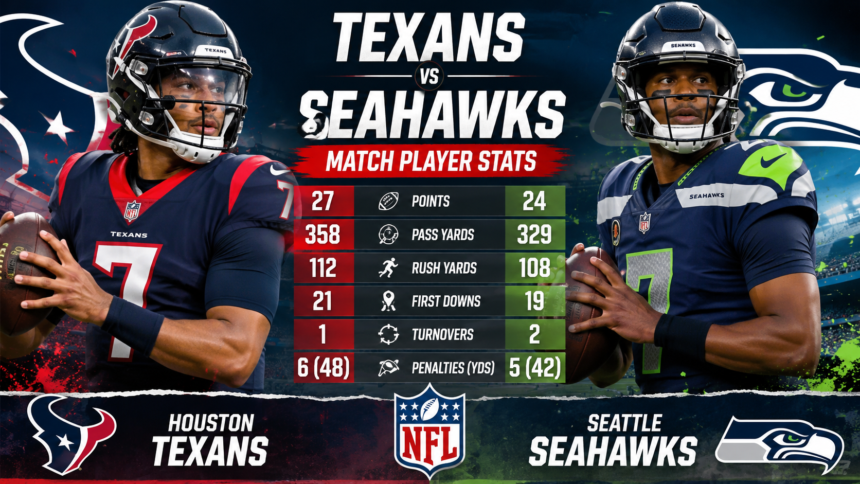
The matchup between the Houston Texans and the Seattle Seahawks was one of those games where the final impression is not just about the score, but about how each player influenced the rhythm of the game.
- Match Overview – Two Different Football Philosophies Collide
- Quarterback Performance – Efficiency vs Aggression Battle
- Running Game Analysis – Control vs Explosive Burst Strategy
- Wide Receivers & Passing Game – Precision vs Vertical Attack
- Defensive Performance – Structure vs Aggression
- Special Teams Impact – Field Position Matters More Than It Looks
- Key Turning Points – Where the Game Shifted
- Full Team Comparison – Who Had the Advantage?
- Tactical Takeaways – What This Game Really Shows
- Final Thoughts
This detailed breakdown of Texans vs Seahawks match player stats focuses on every key aspect: quarterback efficiency, rushing consistency, receiving impact, defensive execution, turnovers, and momentum shifts. Instead of surface-level numbers, this analysis explains how those stats actually shaped the flow of the game.
What makes this matchup interesting is the contrast in style. One team relied on structured execution and control, while the other leaned heavily on explosive plays and aggressive decision-making. That contrast created a game full of tension, adjustments, and turning points.
Match Overview – Two Different Football Philosophies Collide
From the opening drive, it was clear that both teams entered with different game plans. Houston focused on controlled possession, while Seattle aimed for explosive strikes downfield.
The Texans built their offense step by step, prioritizing short completions, safe reads, and steady rushing attempts. Their goal was simple: maintain possession, avoid mistakes, and wear down the defense over time.
Seattle responded with a more aggressive approach. They attempted deeper passes early, trying to stretch the field and force Houston’s secondary into uncomfortable situations.
Key patterns in Texans vs Seahawks match player stats:
- Houston dominated longer, more structured drives
- Seattle created more high-risk, high-reward plays
- Both defenses adjusted after early offensive bursts
- Momentum shifted multiple times throughout the game
A fitting way to describe the opening phase is: Houston was building pressure slowly like a machine, while Seattle was swinging for momentum-changing plays.
Quarterback Performance – Efficiency vs Aggression Battle
Quarterback performance played one of the biggest roles in shaping Texans vs Seahawks match player stats, as both offenses depended heavily on their passing leaders.
Houston’s quarterback focused on rhythm-based football. Short throws, checkdowns, and quick decisions allowed the offense to stay ahead of defensive pressure. This helped maintain long drives and reduce risky situations.
Seattle’s quarterback played with more aggression. He frequently targeted deep routes and tight coverage windows. While this created explosive gains, it also led to inconsistent drive continuity when plays were broken up.
Houston QB performance traits:
- High completion consistency on short and mid-range passes
- Strong decision-making under pressure
- Limited turnovers and controlled tempo
Seattle QB performance traits:
- Higher yards per attempt due to deep throws
- More aggressive risk-taking in tight coverage
- Occasional stalled drives due to incomplete deep attempts
A simple interpretation of Texans vs Seahawks match player stats here is: Houston prioritized control, Seattle prioritized impact.
One analyst-style observation fits perfectly: “A quarterback who avoids chaos often wins the long game, even without highlight moments.”
Running Game Analysis – Control vs Explosive Burst Strategy
The rushing attack played a major role in determining offensive balance.
Houston’s ground game was built on consistency. Their running backs focused on 3–6 yard gains, keeping drives alive and maintaining manageable down-and-distance situations. This approach helped protect the quarterback and control game tempo.
Seattle’s rushing attack was more explosive but less consistent. They had several strong runs that flipped field position, but they struggled to maintain steady production across full drives.
Running game breakdown:
- Houston: consistent gains, strong clock control, fewer negative plays
- Seattle: explosive runs but inconsistent chain movement
- Red zone rushing slightly favored Houston’s efficiency
The contrast is important in understanding Texans vs Seahawks match player stats. Houston treated the run game as a foundation, while Seattle used it more as a surprise weapon.
A useful analogy: Houston ran like a metronome keeping steady rhythm, while Seattle ran like a spark that could ignite suddenly but not always consistently.
Wide Receivers & Passing Game – Precision vs Vertical Attack
The receiving units showed one of the clearest differences in playing style.
Houston’s receivers focused on timing routes, quick separation, and short-yardage reliability. These plays helped maintain offensive rhythm and convert third downs effectively.
Seattle’s receivers, meanwhile, were used to stretch the field vertically. They attacked sideline routes, deep posts, and contested catches, often generating big gains when successful.
Receiving performance insights:
- Houston: higher catch volume, stronger short-yard production
- Seattle: fewer receptions but significantly higher yards per catch
- Both teams contributed in key third-down conversions
A fitting description of Texans vs Seahawks match player stats in the passing game: Houston built steady progress, Seattle searched for instant breakthroughs.
This difference also influenced defensive adjustments, as Houston’s approach forced tighter zone coverage, while Seattle forced defensive backs to stay deeper.
Defensive Performance – Structure vs Aggression
Defense played a crucial role in balancing this matchup.
Houston’s defense focused on discipline and structure. Instead of relying heavily on blitz packages, they emphasized coverage integrity, gap control, and tackling fundamentals. This reduced the number of explosive plays allowed.
Seattle’s defense was more aggressive. They generated strong pass rush pressure and forced the quarterback into quicker decisions. However, aggressive blitzing occasionally opened short passing lanes.
Defensive comparison:
- Houston: better consistency in preventing long drives
- Seattle: stronger pass rush pressure and disruption moments
- Turnovers were relatively balanced on both sides
A coaching philosophy that fits this matchup is: “Pressure wins moments, but discipline wins games.” That idea is deeply reflected in Texans vs Seahawks match player stats.
Special Teams Impact – Field Position Matters More Than It Looks
Special teams quietly influenced momentum throughout the game.
Punting accuracy and coverage units played a major role in field position battles. Pinning offenses deep forced longer drives and increased defensive pressure.
Field goal execution also helped both teams convert stalled drives into points, keeping scoring margins tight.
Special teams highlights:
- Effective punting controlled territorial advantage
- Kick returns occasionally shifted field position quickly
- Field goals added consistent scoring support
Even though less visible, these moments had a strong influence on Texans vs Seahawks match player stats and overall game flow.
Key Turning Points – Where the Game Shifted
Several moments defined the direction of the match.
A key defensive stop on third down prevented a scoring opportunity and shifted momentum. Later, a deep completion created a sudden field position swing that energized the offense.
Major turning moments:
- Red zone defensive stand changed scoring momentum
- One explosive pass shifted field position instantly
- Late defensive pressure forced critical stalled drives
These moments show that Texans vs Seahawks match player stats are not just about totals, but about timing and impact.
Full Team Comparison – Who Had the Advantage?
When analyzing overall performance, both teams showed strengths in different areas.
Houston’s advantages:
- Higher offensive consistency
- Better third-down conversion control
- Stronger game management and tempo control
Seattle’s advantages:
- More explosive offensive plays
- Stronger pass rush impact moments
- Higher big-play yardage potential
This creates a clear contrast: Houston played controlled football, Seattle played explosive football.
That contrast is the central theme of Texans vs Seahawks match player stats.
Tactical Takeaways – What This Game Really Shows
This matchup highlights two winning formulas in modern football.
Houston’s approach shows that consistency, discipline, and structured offense can control games even without explosive plays. Their ability to sustain drives is their biggest strength.
Seattle’s approach shows that explosive talent can change games instantly, but inconsistency can limit overall control.
Key tactical lessons:
- Consistency beats chaos over long drives
- Explosiveness can shift momentum quickly
- Balance between both styles is ideal
In modern football, both styles can win—but only when execution matches strategy.
Final Thoughts
The game between the Houston Texans and the Seattle Seahawks was a balanced and strategically rich contest where every phase mattered.
The full Texans vs Seahawks match player stats tell a deeper story: Houston controlled structure and rhythm, while Seattle relied on explosive opportunities and aggressive playmaking.
In the end, football is decided not just by talent, but by consistency under pressure—and that was the defining difference in this matchup.
Also Read: Herald Magazine